
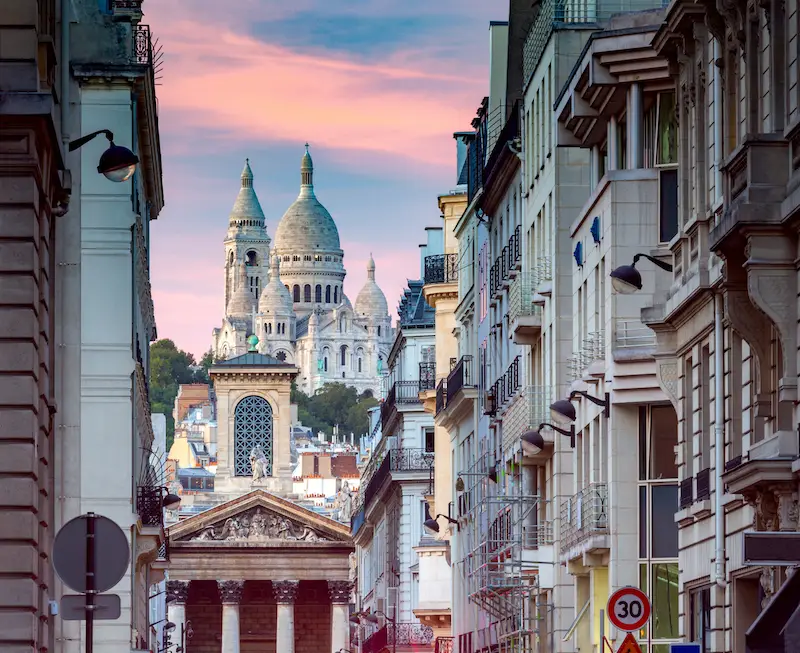
Start at Abbesses métro, wind up through the village streets to Place du Tertre, and finish at the Sacré-Cœur — about 90 minutes on foot, or less if you take the funicular for the final climb. Montmartre is a hill, and how you walk it determines whether you arrive at the top charmed or exhausted. This is the route to take, in order, with the decisions that matter along the way.
For the stories behind what you’ll pass — the artists, the vineyard, the hidden passages — our guide to the secrets of Montmartre is the companion to this one. This article is about the walk itself.
Which Métro Stop to Use
This is the first decision, and most people get it wrong.
Use Abbesses (Line 12), not Anvers. Here’s why it matters:
- Abbesses puts you in the heart of the village, partway up the hill, with the charming streets immediately around you. You walk up through the best of Montmartre.
- Anvers (Line 2) drops you at the bottom of the tourist drag — a straight, crowded, souvenir-shop climb up Rue de Steinkerque to the foot of the Sacré-Cœur stairs. It’s the least pleasant approach.
- Blanche (Line 2), by the Moulin Rouge, works if you want to start with the cabaret landmark and climb from there.
Abbesses is also the more theatrical arrival. It’s one of the deepest stations in Paris — take the elevator rather than the spiral staircase — and it surfaces beneath one of the original Art Nouveau glass canopies, of which only a couple survive in the city.
The Route, Stop by Stop
- Place des Abbesses
You emerge here. Take a moment — the square is pretty, low-key, and a good orientation point before the climb. The “I Love You” wall (Le mur des je t’aime), covered in the phrase in hundreds of languages, is just off the square if that appeals.
- Up through the village streets
From Abbesses, work your way uphill. This is where you follow your instincts rather than a straight line — the pleasure of Montmartre is the wandering, and the hill guarantees you can’t get badly lost. Head generally upward and you’ll thread through the quiet, sloping streets that give the district its village feel.
Aim to pass:
- Rue de l’Abreuvoir — often called the prettiest street in Paris, pastel houses opening onto a view of the Sacré-Cœur
- La Maison Rose — the pink café on the corner, one of the most painted spots in the quarter
- The Montmartre vineyard (Clos Montmartre) — a genuine working vineyard, a survivor of the district’s rural past, just below the summit
- Place du Tertre
The old heart of artistic Montmartre, and now its busiest point. Painters still set up easels here, offering portraits and selling work, as they have since this was the centre of the Parisian art world. It’s touristy and it’s crowded — but it’s also the real historical core, and worth a slow pass-through.
A tip: it’s at its worst in the middle of the day. Early morning or early evening, it’s a different, calmer place.
- The Sacré-Cœur
From Place du Tertre it’s a two-minute walk to the basilica, and you arrive at it from behind and above — which is the elegant way in, skipping the crowded frontal stair climb entirely.
The Final Climb: Stairs or Funicular?
If you approach from below (from Anvers), you face the famous tiered staircase up to the basilica. Here’s the choice:
| Option | Best for |
| The stairs | The classic ascent and the view opening up behind you as you climb |
| The funicular | Saving your legs — it’s covered by a standard métro ticket |
The funicular is the practical secret: it runs on a normal Paris métro/bus ticket, so if you’re tired or with children, there’s no reason to grind up the steps. If you’ve taken the Abbesses route, though, you arrive from the top and skip this decision altogether.
At the Summit
The Sacré-Cœur is free to enter, and worth going inside for the interior mosaic. The real reward, though, is the view.
- From the basilica steps — the standard panorama over Paris, and one of the best free views in the city
- From the dome — for a fee, you can climb the dome, and on a clear day the view reaches up to 30 kilometres
The dome climb is a genuine extra, not a rehash of the terrace view — it’s higher, wider, and far less crowded than the steps below.
How Long It Takes
- Abbesses to the Sacré-Cœur, wandering — about 90 minutes, including stops
- A brisk direct walk — 30 minutes
- With the dome climb and time at the top — allow 2 to 2.5 hours for the whole thing
Montmartre is a half-day at most, which makes it a natural afternoon after a morning elsewhere. Our 3-day Paris itinerary places it exactly this way — as the second half of a day that begins at Notre-Dame and the Latin Quarter.
Practical Notes
- Wear proper shoes. This is a hill of cobbles and stairs. It is not a walk for smooth soles.
- Go early or late. Place du Tertre and the basilica steps are busiest midday. Morning light and evening quiet are both better.
- Watch your belongings on the crowded approaches and around the basilica steps, as in any busy Paris spot.
- The funicular runs on a standard ticket — keep one spare.
- It’s a working church. Dress and behave accordingly inside; it’s free, and it’s still a place of worship.
To have the district’s history unlocked as you walk it — the passages, the artists’ studios, the stories that aren’t visible from the street — a guided walk is worth it. See our Paris tours for options.
FAQ
What’s the best métro stop for Montmartre?
Abbesses (Line 12). It puts you in the heart of the village so you walk up through the best streets, rather than Anvers, which leaves you at the bottom of the crowded souvenir drag.
How long does it take to walk up to the Sacré-Cœur?
About 90 minutes from Abbesses if you wander through the village streets and stop along the way, or around 30 minutes walking directly. Add time for the dome climb at the top.
Do you have to climb stairs to reach the Sacré-Cœur?
Not necessarily. If you approach from Abbesses you arrive from above and skip the stairs. From below, a funicular covered by a standard métro ticket saves you the climb.
Is the Sacré-Cœur free to enter?
Yes, the basilica is free. Climbing the dome costs a fee, but it’s worth it — on a clear day the view reaches up to 30 kilometres.
Is Montmartre worth visiting?
Yes. It’s a hilltop village within the city, with artists’ squares, a working vineyard, the prettiest streets in Paris, and one of the best free views in the city from the Sacré-Cœur.
When is the best time to visit Montmartre?
Early morning or early evening. Place du Tertre and the basilica are most crowded in the middle of the day; the light and the calm are both better at the edges of the day.


