
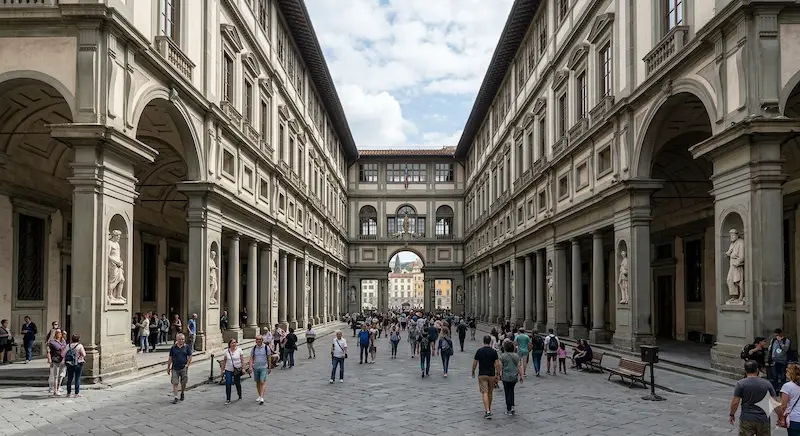
If you can only visit one, choose the Uffizi for the breadth of Renaissance painting, or the Accademia for Michelangelo’s David. They are not interchangeable and they are not competing for the same visit — the Uffizi is a large painting gallery you sample, the Accademia is a compact sculpture museum you can finish in an hour. Which comes first depends on what you came to Florence to see. Here’s the reasoning.
The Core Difference
The Uffizi is a painting gallery, and one of the most important in the world. Botticelli’s Birth of Venus and Primavera, works by Leonardo, Raphael, Caravaggio, Titian — the collection traces the Renaissance across dozens of rooms in a former Medici administrative building. It is large, and it cannot be seen quickly.
The Accademia is, for most visitors, one statue. Michelangelo’s David is the reason people come, and it earns the visit on its own. The gallery holds more — the unfinished Prigioni (“Prisoners”), other Michelangelo works, a collection of Florentine painting — but it is a fraction of the Uffizi’s size and a fraction of the time.
The practical consequence: these are different lengths of visit, not two versions of the same one.
Side by Side
| Uffizi Gallery | Accademia Gallery | |
|---|---|---|
| Type | Painting gallery | Primarily sculpture |
| Famous for | Botticelli’s Birth of Venus, Primavera | Michelangelo’s David |
| Also holds | Leonardo, Raphael, Caravaggio, Titian | The Prigioni, Florentine painting |
| Realistic visit | 2.5–3 hours | Under 1.5 hours |
| Guided express tour | 1.5 hrs, skip-the-line, max 20 | Under 2 hrs, skip-the-line |
| Size | Very large | Compact |
| Queue without booking | Notoriously long | Long, especially for the David |
| Best for | Renaissance painting, breadth | Michelangelo, a focused visit |
How Long Each One Takes
This is the deciding factor for most itineraries.
The Uffizi needs two and a half to three hours to cover the highlights at your own pace — or about 1.5 hours on a guided express tour that takes you straight to the key works and skips the rest. The building is large, the route is long, and the full collection rewards time.
The Accademia needs under ninety minutes, and the David and Prisoners alone can be seen in forty-five. It’s a small museum, and its most common mistake is people queuing longer to get in than they spend inside.
Combined, that’s an entire day of museum-going — which is why, on a short trip, the order matters.
Which to Visit First
If you have one day in Florence
Pick one, and let the other go. A single day should include the Duomo, Piazza della Signoria, the Ponte Vecchio, and one gallery — not both. Choose the Uffizi if you love painting, the Accademia if seeing the David is non-negotiable. Trying to do both plus the city in a day produces a blur.
If you have two days
Accademia first, on the morning of day one. It’s shorter, it’s the single most in-demand ticket in Florence, and getting it done early frees the rest of your time. Save the Uffizi for a morning when you have three unhurried hours.
If the David is the reason you came
Accademia first, regardless. Don’t spend your energy on three hours of Uffizi and arrive at the David depleted. See it while you’re fresh.
If Renaissance painting is the reason you came
Uffizi first. The Accademia will feel slight afterwards if painting is your priority — better to lead with the collection that matters to you.
The One Thing That Matters More Than the Order
Book both in advance. This is not optional advice for these two museums specifically.
The busiest hours in Florence run from mid-morning to mid-afternoon, and standing in line at either gallery can consume hours in peak season. Our guide to avoiding crowds at Florence’s major attractions covers the timing in detail, but the essential points are simple: reserve ahead, and go early. For the Accademia in particular, the morning slots are the first to sell out.
Our Uffizi Gallery express small group tour does the same for the Uffizi — 1.5 hours, skip-the-line, a licensed local guide, and a maximum of 20 people. For the Uffizi in particular this is the visit most worth booking guided: the queue is among the longest in the city, and the collection is large enough that a guide pointing you to what matters saves you from wandering it blind.
A Note on What Each Museum Feels Like
Beyond logistics, they’re different experiences.
The Uffizi is immersive and demanding. Room after room of painting, a chronological sweep through the Renaissance, and by the end most visitors are saturated. It’s magnificent and it’s a lot.
The Accademia is focused and, unexpectedly, moving. The approach to the David — down a corridor lined with the half-finished Prisoners emerging from raw marble — is deliberately staged, and the statue at the end of it is larger and more affecting in person than photographs prepare you for. It’s a short visit that lands hard.
For a fuller picture of the city’s essential sights, see our guide to the top 5 must-see sights in Florence, and for the range of options, our Florence tours.
FAQ
Should I visit the Uffizi or the Accademia first?
If seeing Michelangelo’s David is your priority, do the Accademia first, while you’re fresh. If Renaissance painting matters more, start with the Uffizi. On a two-day trip, book the Accademia for the first morning — it’s the hardest ticket to get.
Can you visit both the Uffizi and the Accademia in one day?
It’s possible but heavy — together they’re close to a full day of museum-going. If you do both, put the shorter Accademia first and give the Uffizi a fresh block of three hours, ideally with a proper break between them.
Which is better if I only have time for one?
The Uffizi for the breadth of Renaissance painting; the Accademia for the David. There’s no universal answer — it depends on whether you came for paintings or for Michelangelo.
How long do you need at the Uffizi?
Two and a half to three hours for the highlights at your own pace, or about 1.5 hours on a guided express tour. Seeing the whole collection takes longer still.
How long do you need at the Accademia?
Under ninety minutes, and the David and Prisoners alone take about forty-five. It’s a compact museum.
Is the David in the Accademia the original?
Yes. The original David is in the Accademia; the copy stands in Piazza della Signoria where the statue was originally placed.
Do I need to book tickets in advance for both?
Yes. Both draw long queues, and advance booking is the most effective way to avoid losing hours in line — especially at the Accademia, where morning slots sell out first.


