
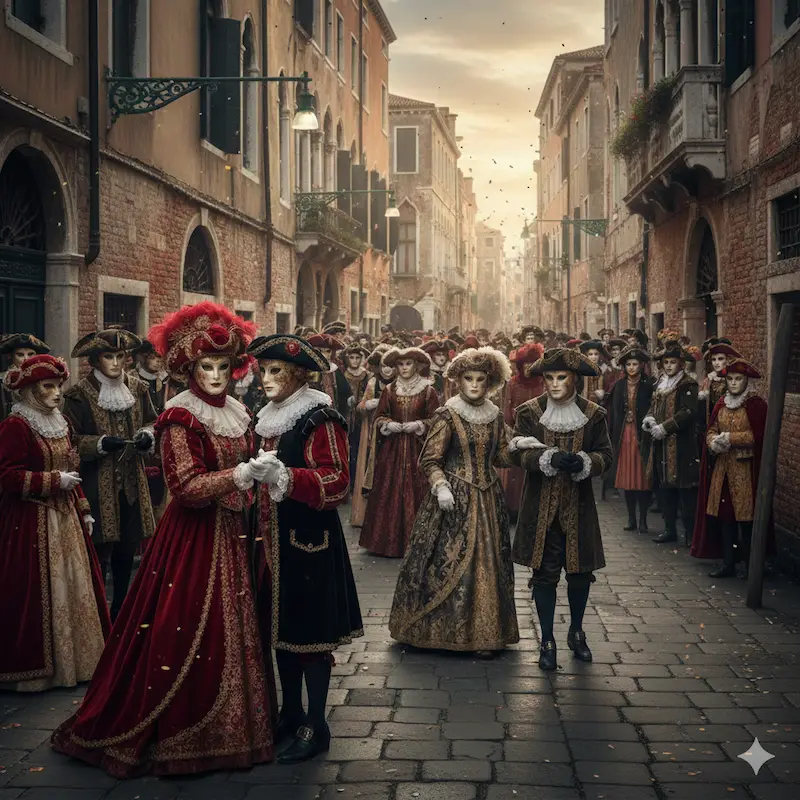
Around the world, carnivals are known for parades, music, and exuberant celebration. Venice offers something profoundly different. The Venice Carnival is not about spectacle alone—it is about identity, anonymity, and transformation. Born from a unique social system and shaped by centuries of power, control, and freedom, it remains unmatched anywhere else.
To truly grasp its meaning beyond masks and photos, our Venice tours often explore the historical and symbolic roots of Carnival, revealing why this celebration could only have been born in Venice.
A Carnival Built on Anonymity, Not Performance
Most carnivals invite people to stand out. Venice Carnival historically allowed people to disappear. Masks were not worn to attract attention, but to erase social distinctions.
Behind a mask, a noble could mingle with a commoner, a merchant with an aristocrat, a woman with freedoms otherwise denied. This temporary suspension of identity made Venice Carnival a social experiment, not a parade.
Masks as Social Equalizers
Venetian masks were not decorative accessories. They were tools.
They allowed:
-
Equality between social classes
-
Freedom of speech without consequence
-
Access to spaces normally restricted by rank
-
Anonymous participation in political and social life
No other carnival used disguise so systematically or for so long.
A Carnival That Lasted Months
Unlike modern carnivals confined to a few days, Venice Carnival historically lasted weeks or even months. In some periods, masks were permitted from October until Lent.
This extended duration meant Carnival was not an escape from daily life—it became part of daily life. The city itself functioned differently under the protection of anonymity.
A City Designed for Carnival
Venice’s architecture amplified Carnival’s power. Narrow calli, shadowed courtyards, and candlelit interiors made disguise effective. Sound traveled strangely. Faces were half-hidden. Encounters were fleeting.
The city did not just host Carnival—it enabled it. Few cities in the world are so perfectly suited to secrecy and illusion.
Pleasure, Control, and Political Stability
Paradoxically, the Venetian Republic encouraged Carnival not to promote chaos, but to control it.
By allowing excess, disguise, and temporary freedom, authorities reduced social tension. Carnival became a pressure valve, releasing desire and frustration in a regulated timeframe.
This balance between indulgence and order is unique to Venice’s political system.
No Floats, No Confetti, No Noise
Unlike carnivals in Rio or New Orleans, Venice Carnival traditionally had no massive floats or constant noise. Its power lay in silence, glances, and suggestion.
A masked figure standing still in a square could be more unsettling—and more fascinating—than any parade.
A Living Tradition, Not a Reenactment
Despite its historic roots, Venice Carnival is not a museum piece. While costumes reference the past, the experience remains alive:
-
Masks still create anonymity
-
The city still transforms socially
-
Visitors still become participants, not spectators
Few carnivals preserve this level of continuity between past and present.
Why No Other City Can Replicate It
Many cities imitate Venetian masks. None can recreate:
-
A republic built on secrecy
-
A city without cars or modern barriers
-
A tradition rooted in social engineering
-
Architecture designed for concealment
The Venice Carnival is inseparable from Venice itself.
Final Thoughts
The Venice Carnival is unlike any other in the world because it was never meant to entertain—it was meant to transform society, if only temporarily.
It is a celebration of anonymity over identity, mystery over display, and freedom over recognition. To experience it is not to watch a festival, but to step into a city where, for a brief moment, who you are no longer matters.


