
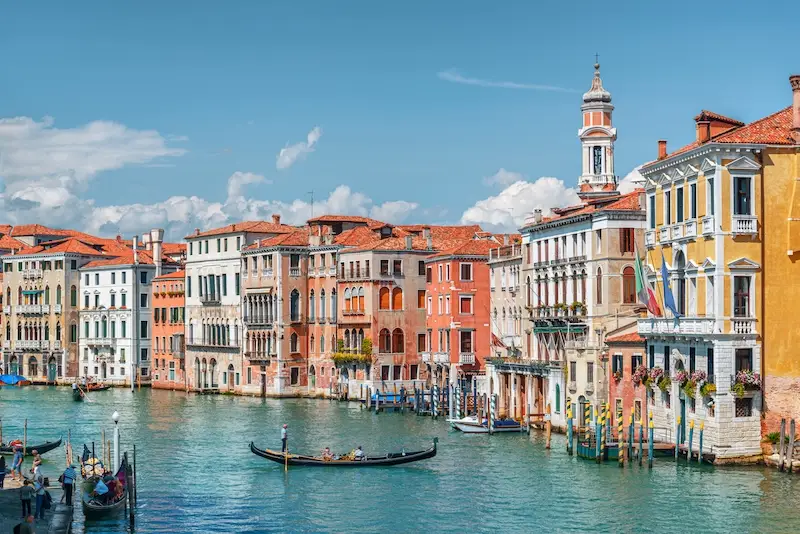
See the busiest sights — St. Mark’s Square, the Basilica, the Rialto — before 9:00 AM, spend the crowded midday hours in the quiet back sestieri, and return to the landmarks in the late afternoon. Venice’s crowds are extreme but predictable: they arrive with the day-trippers late morning and thin out by evening. Timing your day around that single pattern is the difference between fighting through crowds and having the city to yourself. Here’s the hour-by-hour plan.
The One Pattern That Explains Venice’s Crowds
Venice’s crowd problem is largely a day-tripper problem. Huge numbers of visitors arrive mid-morning — from cruise ships, tour buses, and mainland trains — flood the main sights through the middle of the day, and leave by early evening.
That creates a reliable daily rhythm:
- Before ~9:30 AM — quiet. The day-trippers haven’t arrived.
- ~10:00 AM to ~4:00 PM — peak. The main routes and sights are packed.
- After ~5:00 PM — quiet again. The crowds have gone home.
Everything below follows from this. Plan your day inside-out — landmarks at the edges, backstreets in the middle — and Venice transforms.
Early Morning (7:00–9:30): The Main Sights
This is the most valuable window of the day. Use it for the busiest places.
- St. Mark’s Square — at dawn it’s close to empty, and the rising sun striking the Basilica’s domes is one of the great Venice sights. By mid-morning this same square is at its most crowded. The contrast is total.
- St. Mark’s Basilica — the single most crowded interior in Venice, with long lines just about any time of day. Being there when it opens is the only reliable way to avoid them. Note the dress code (shoulders and knees covered), enforced at the door.
- The Rialto Bridge — photographers are advised to arrive before 8:00 AM. Early, you can actually see the bridge and the Grand Canal from it; later, you see the backs of other visitors.
Do the thing everyone wants to do, before everyone wants to do it. An early start is worth more in Venice than in almost any other city.
Late Morning to Mid-Afternoon (10:00–16:00): Escape the Crowds
Once the day-trippers arrive, stop competing with them. This is the wrong time to be at St. Mark’s — and the right time to discover the Venice most visitors never see.
The city empties out dramatically just a few streets away from the main routes. Spend these hours in the quieter sestieri:
- Cannaregio — one of the most authentic districts, with canal-side walks and local life
- Castello — the largest sestiere, and residential once you’re past the Basilica’s shadow
- Dorsoduro — art (the Accademia, the Guggenheim) and a calmer, student-ish atmosphere
This is also the time for lunch and for indoor sights that aren’t St. Mark’s. The trick is simply not to be where the crowds are while they’re there.
The Rialto Market: A Special Case
One sight breaks the “early is quiet” rule in the other direction — it requires early, because it closes.
The Rialto Market operates in the morning and winds down by early afternoon. The fish market is closed on Mondays and Sundays. If the market is on your list, it’s a morning-only stop — go before it packs up, not to avoid crowds but to catch it open at all.
Late Afternoon and Evening (17:00 onward): The Landmarks Again
As the day-trippers leave, the main sights become pleasant again — and take on a completely different atmosphere.
- St. Mark’s Square at dusk — the crowds gone, the cafés’ orchestras playing, the light golden. Many visitors find the evening square more romantic than any other time.
- The Grand Canal at golden hour and blue hour — the best light of the day for the palaces along the water. Our Grand Canal guide covers the best stretches and viewpoints for exactly these hours.
- A gondola ride at sunset — the classic end to a Venice day, and far more atmospheric than a midday one. Our guide to sunset gondola rides covers where and when.
The evening is when Venice is at its best, and it’s free — it costs only the discipline of not sleeping in.
The Ideal Day, at a Glance
| Time | Where | Why |
|---|---|---|
| 7:00–9:30 | St. Mark’s Square, Basilica, Rialto | Empty before the day-trippers |
| 9:30–12:00 | Rialto Market, then quiet sestieri | Market closes early; crowds building |
| 12:00–16:00 | Cannaregio, Castello, Dorsoduro; lunch | Escape the peak crowds entirely |
| 16:00–18:00 | Doge’s Palace, indoor sights | Crowds beginning to thin |
| 18:00 onward | St. Mark’s Square, Grand Canal, gondola | Landmarks quiet and atmospheric |
Seasonal Notes
The daily pattern holds year-round, but its intensity changes:
- Summer (Jun–Aug) — the pattern is at its most extreme. Early mornings are essential, not optional.
- Carnival (Feb) — crowds are heavy and less predictable; the usual quiet windows shrink.
- Winter (Nov–Feb, outside Carnival) — the calmest time overall, though acqua alta (high water) is more likely and can affect access to low-lying areas like St. Mark’s Square.
- Spring and autumn — the best balance of manageable crowds and good weather.
Practical Notes
- An early start is the highest-value decision in Venice. More than any ticket or route, it determines the quality of your day.
- Book the Basilica and Doge’s Palace ahead regardless of timing — the lines are long enough that skip-the-line access matters even in the quiet hours.
- Getting slightly lost in the midday backstreets is the point, not a problem — the quiet sestieri are best explored without a fixed route.
- Wear comfortable shoes. Venice is walking, stairs, and bridges all day.
If you’d rather have the timing handled for you — arriving at each sight at the right hour, with skip-the-line access — a guided tour takes the planning off your plate. See our Venice tours for options.
FAQ
What’s the best time of day to visit St. Mark’s Square?
Early morning, before about 9:30, when it’s nearly empty and the sunrise lights the Basilica — or the evening, after the day-trippers leave, when it’s quiet and atmospheric. Avoid roughly 10:00 to 4:00, when it’s at its most crowded.
When should I visit St. Mark’s Basilica to avoid crowds?
Right when it opens. The Basilica has the longest lines of any interior in Venice at almost any time of day, so an early arrival is the only reliable way to avoid them.
What’s the best time to see the Rialto?
Before 8:00 AM for the bridge and the Grand Canal views without crowds. The Rialto Market is a morning-only sight — it winds down by early afternoon and is closed Sundays and Mondays for fish.
What should I do during the crowded midday hours in Venice?
Leave the main sights to the day-trippers and explore the quieter sestieri — Cannaregio, Castello, Dorsoduro — where the city empties out just a few streets from the crowds. It’s also the time for lunch and indoor sights away from St. Mark’s.
Is Venice better in the morning or the evening?
Both beat midday. Mornings are best for seeing the main sights empty; evenings are best for atmosphere, light, and a gondola ride. The middle of the day is the time to be away from the landmarks.
Does the crowd pattern change by season?
The daily rhythm holds year-round but intensifies in summer and during Carnival. Winter is quietest, though high water is more likely; spring and autumn offer the best balance of crowds and weather.


