
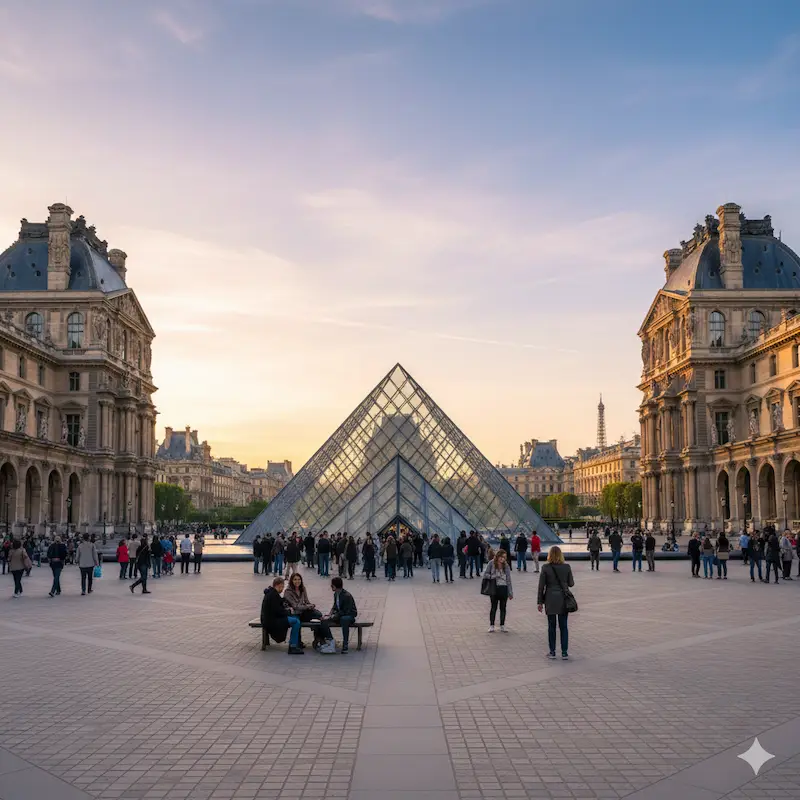
You can see the Louvre’s essential masterpieces in about three to four hours with a plan: enter early, head to the Denon wing first for the Mona Lisa and the Italian Renaissance, then the great sculptures, and accept that you’re sampling, not completing. The Louvre is the largest art museum in the world — nobody sees it all in a day, and trying is how people end up exhausted and remembering nothing. Here’s a route through the essentials that actually works.
First, Accept What You Can’t Do
The Louvre holds around 35,000 works on display across a former royal palace so large that “seeing the Louvre” in the complete sense would take days. In 2025 it drew nine million visitors — the most-visited museum on earth.
On a half-day visit, you are curating, not surveying. The visitors who leave satisfied are the ones who picked a handful of masterpieces and saw them well. The ones who leave drained tried to see everything and saw a blur of corridors.
This route covers the universally famous works — the ones you’d regret missing — in a logical path that minimises backtracking. Treat it as a spine, and detour only where something genuinely grabs you.
Before You Go: Two Decisions That Save an Hour
- Book a timed entry slot in advance. This is non-negotiable. Advance booking is essential to save time, and turning up without a ticket means the longest queue of your day.
- Use the right entrance. The glass Pyramid is the famous entrance and the most crowded. Pre-booked ticket holders can often use less congested access points — knowing this before you arrive saves you from the worst of the crush.
The Route
The Louvre has three wings around the central Pyramid: Denon, Sully, and Richelieu. Most of the headline masterpieces are in Denon, which is why the route starts there — do the busiest wing first, while you and the museum are both fresh.
- Start in Denon — the Italian Renaissance
Head straight for the Denon wing and the Italian paintings. This is where the crowds will build through the day, so getting here first matters.
- The Mona Lisa (La Joconde) — go here first, before anything else. By late morning the room is a scrum; early, you have a fighting chance of a real look. Manage your expectations: it’s smaller than people expect, behind glass, at a distance. Seeing it is about ticking the box calmly rather than being moved.
- The Italian Renaissance galleries around it — Leonardo’s other works, Raphael, Titian. These are the quiet triumph: world-class paintings that people walk straight past on the way to the Mona Lisa. Give them the time everyone else gives the crowd.
- The Wedding at Cana by Veronese — the enormous canvas facing the Mona Lisa, taken from Venice by Napoleon in 1797. Most people have their backs to it. Turn around.
- The Great Sculptures
Still in and around Denon:
- The Winged Victory of Samothrace — positioned at the top of a staircase, one of the most dramatically displayed works in any museum. You’ll pass it naturally.
- The Venus de Milo — nearby in the Sully wing’s Greek antiquities. The three — Mona Lisa, Winged Victory, Venus de Milo — are the Louvre’s “big three,” and they’re close enough to see in sequence.
- The Medieval Louvre — Beneath Your Feet
Before you leave, go down. In the lower level (Sully) are the foundations of the medieval fortress the museum was built on — massive stone remains of the original Louvre, a castle before it was ever a palace.
It’s a complete change of register from the galleries above, and far less crowded. For the full story of the fortress and why it was built for war rather than beauty, our article on the Louvre before the museum is the companion to this stop.
- If You Have Time Left — Richelieu
If you’re not yet saturated, the Richelieu wing is the least crowded of the three and a calm way to end: French painting, Napoleon III’s opulent apartments, and Mesopotamian antiquities. It’s the wing to wander without an agenda once the must-sees are behind you.
The Half-Day Shape, at a Glance
| Order | Stop | Wing |
| 1 | Mona Lisa — first thing | Denon |
| 2 | Italian Renaissance galleries | Denon |
| 3 | The Wedding at Cana | Denon |
| 4 | Winged Victory of Samothrace | Denon/Sully |
| 5 | Venus de Milo | Sully |
| 6 | Medieval Louvre foundations | Sully (lower) |
| 7 | Richelieu — if time and energy remain | Richelieu |
Three to four hours, unhurried. That’s a genuine half-day, and a satisfying one.
The Mistakes That Ruin a Louvre Visit
- Not booking ahead. The single biggest time-waster. Reserve a slot.
- Going to the Mona Lisa last. By then the room is impassable. It’s the one thing to do first.
- Trying to see everything. The museum is too big. A plan beats stamina every time.
- Only seeing the Mona Lisa. The Renaissance rooms around it are less crowded and, many would say, more rewarding. Don’t queue for one painting and skip the masters beside it.
- Ignoring the lower level. The medieval foundations are one of the Louvre’s quietest and most atmospheric spaces, and most visitors never go down.
Fitting It Into Your Trip
The Louvre is a half-day, which pairs naturally with something lighter in the afternoon — a walk along the Seine, the Tuileries gardens next door, or the nearby bridges. Our 3-day Paris itinerary places the Louvre on the first afternoon, and it slots in well after a morning at the Eiffel Tower or on the Île de la Cité.
If you’d rather see more of Paris’s art without the crowds, our guide to the hidden art museums of Paris covers the intimate collections that make a good counterpoint to the Louvre’s scale. For guided experiences in the city, see our Paris tours.
FAQ
Can you see the Louvre in half a day?
Yes, if you focus on the essentials. Three to four hours is enough to see the Mona Lisa, the Italian Renaissance galleries, the Winged Victory, the Venus de Milo, and the medieval foundations — a satisfying visit. You can’t see the whole museum in that time, and shouldn’t try.
What are the must-see works at the Louvre?
The “big three” are the Mona Lisa, the Winged Victory of Samothrace, and the Venus de Milo. Beyond those, the Italian Renaissance galleries around the Mona Lisa and Veronese’s Wedding at Cana are the highlights most worth your time.
Should I see the Mona Lisa first or last?
First. The room becomes extremely crowded as the day goes on, so seeing it early — right when you arrive — gives you the best chance of a proper look before the crush builds.
Which Louvre entrance is best?
The glass Pyramid is the most famous and the most crowded. With a pre-booked ticket you can often use quieter access points, so booking ahead helps you skip the worst of the entrance queue.
How long does the Louvre really take?
As long as you give it — the full collection would take days. For the essential masterpieces on a focused route, three to four hours is realistic. Seeing “everything” is not a half-day goal.
Do I need to book Louvre tickets in advance?
Yes. Advance timed-entry booking is essential — it’s the most effective way to avoid the long entrance queues, which are the biggest single delay at the museum.


