
Rome is a city of fountains. While the Trevi Fountain and Fontana dei Quattro Fiumi draw crowds from around the world, the Eternal City is also home to dozens of lesser-known fountains—smaller, quieter, but no less rich in history, artistry, and charm.
Follow this curated itinerary to explore Rome through a refreshing and unexpected path, discovering elegant waterworks tucked away in piazzas, courtyards, and alleyways.
Want to experience Rome beyond the usual highlights? Join one of our Rome walking tours, designed to reveal the city’s secret corners and hidden fountains.
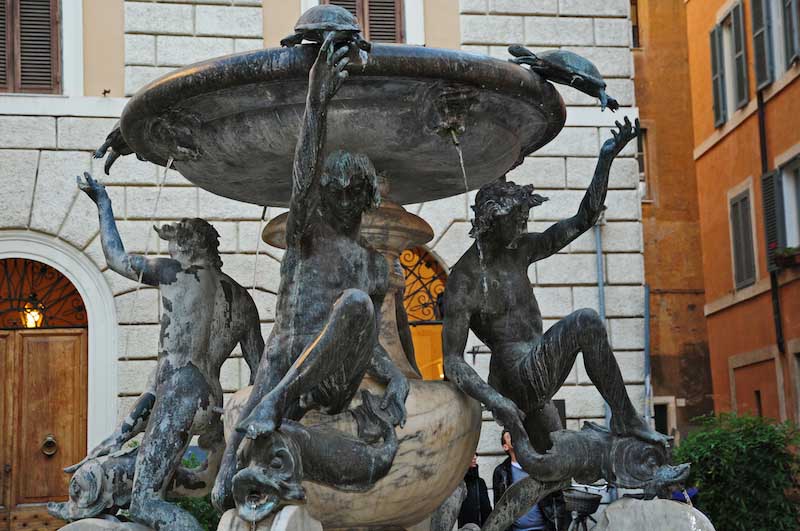
Fontana delle Tartarughe – The Turtle Fountain in Piazza Mattei
Tucked away in the Jewish Ghetto, the Fontana delle Tartarughe is one of the most delicate and harmonious fountains in Rome. Built in the late 16th century by Giacomo della Porta, its elegant bronze figures were later modified by Bernini, who added the playful turtles.
The small piazza surrounding the fountain is serene, and the sculptural details make it a favorite among artists and architecture lovers.
Fontana del Facchino – The Water Carrier on Via Lata
Often missed by passersby, the Fontana del Facchino is one of the six “talking statues” of Rome—ancient figures used to post anonymous political messages.
Located on Via Lata, this small fountain features a man carrying a barrel, likely a depiction of a 16th-century street vendor. Its modest size belies its historical importance as part of Rome’s satirical tradition.
Fontana di Piazza Sant’Eustachio – Hidden Near the Pantheon
Just a few steps from the tourist-packed Pantheon, Piazza Sant’Eustachio hides a small but beautifully detailed fountain topped with the head of a stag—an allusion to the legend of Saint Eustace.
This quiet square is also home to one of Rome’s most beloved coffee bars, Caffè Sant’Eustachio, making it a perfect stop to rest and recharge during your walk.
Fontana delle Api – Bernini’s Baroque Miniature
Located at the corner of Via Veneto and Piazza Barberini, the Fountain of the Bees is a small masterpiece by Gian Lorenzo Bernini, created in 1644.
The fountain features three bees on a large scallop shell, representing the Barberini family crest. Though modest in size, it’s a brilliant example of Bernini’s ability to blend symbolism and function.
Fontanella del Mascherone – The Mask Fountain on Via Giulia
On the elegant Via Giulia, a 16th-century street designed for papal processions, you’ll find the Fontanella del Mascherone—a solemn stone mask that spits water into a marble basin.
The fountain was once connected to temporary wine flows during celebrations, and the contrast between its grotesque face and refined setting creates a captivating scene.
Fontana dell’Acqua Paola – The Janiculum’s Grand Surprise
Though larger than others on this list, the Fontana dell’Acqua Paola (or “Il Fontanone”) remains one of Rome’s best-kept secrets for those who venture up the Janiculum Hill.
Built in 1612 as a monumental display of restored aqueducts, it offers panoramic views over the city and is often less crowded than more central sites. It’s particularly beautiful at sunset and has appeared in several Italian films, including La Grande Bellezza.
How to Follow This Itinerary
This route is walkable and can be done in half a day at a relaxed pace:
-
Start at Piazza Mattei (Turtle Fountain)
-
Head north to Via Lata (Fontana del Facchino)
-
Continue toward the Pantheon to reach Piazza Sant’Eustachio
-
Walk to Piazza Barberini and down Via Veneto (Fontana delle Api)
-
Cross to Via Giulia (Fontanella del Mascherone)
-
Finish with a scenic climb to Gianicolo Hill (Fontana dell’Acqua Paola)
Wear comfortable shoes and bring a water bottle—you’ll pass several nasoni, Rome’s public drinking fountains, along the way.
Final Thoughts
In a city overflowing with artistic treasures, even water becomes an expression of beauty. These hidden fountains of Rome tell stories of families, artists, saints, and celebrations. Walking among them offers a tranquil, reflective journey that reveals the city’s quieter side—one drop at a time.


