
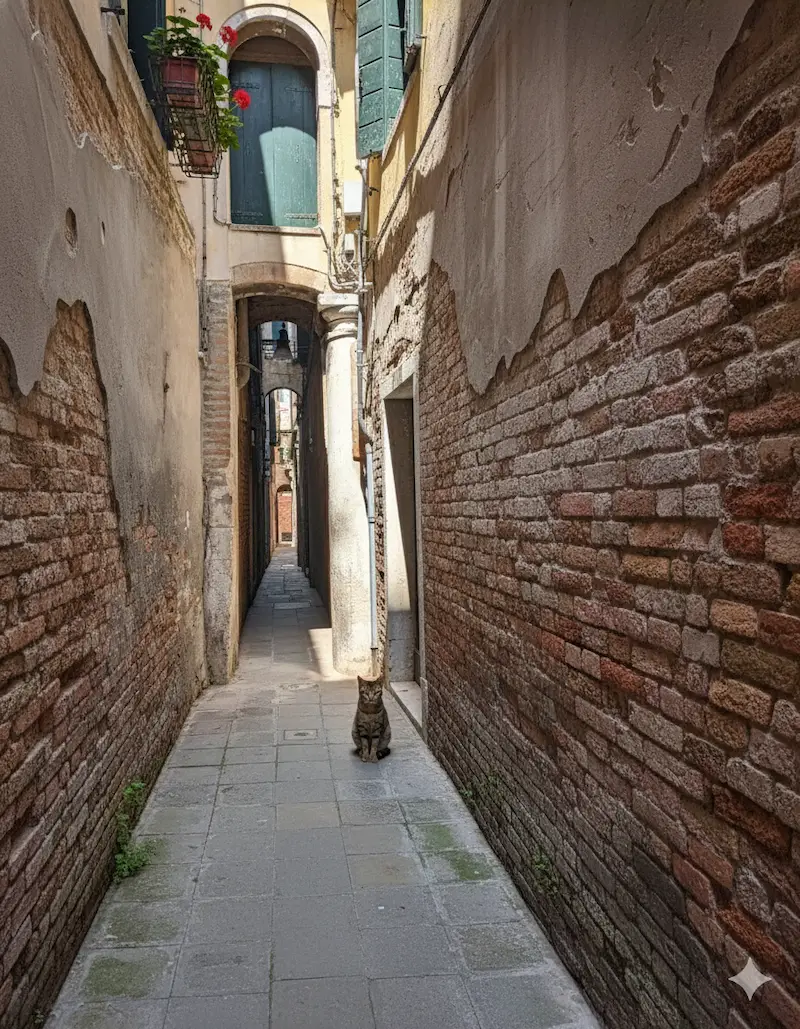
Venice is famous for its canals and grand palaces, but its true character often reveals itself in the city’s narrowest calli—alleys so tight that they feel almost secret. These slender passageways were never meant to impress; they were designed for daily life, efficiency, and control. Walking through them offers a powerful sense of intimacy with the city’s past.
For travelers curious to explore these hidden corners with expert insight, our Venice tours often include lesser-known routes that reveal how these narrow calli shaped everyday Venetian life.
Calle Varisco: The Narrowest of Them All
Tucked away in the Castello district, Calle Varisco is widely considered the narrowest calle in Venice. At its tightest point, it measures just over 50 centimeters wide.
According to local lore, this passage was deliberately built so narrow to prevent ambushes and control movement within the neighborhood. Others claim it was a defensive feature, making it impossible for enemies to pass through quickly or in numbers. Today, squeezing through Calle Varisco feels like stepping into a medieval defensive strategy carved in stone.
Calletta Ruga Giuffa: A Corridor of Daily Survival
Near one of Venice’s longest streets, this tiny side passage was once essential for residents moving between homes, workshops, and storage areas. Narrow calli like this were practical: they reduced exposure to wind, preserved warmth in winter, and maximized precious space in an already crowded city.
These alleys remind visitors that Venice was built not for comfort, but for adaptation.
Calle del Pestrin: Where Milk Once Passed
Some narrow calli take their names from forgotten professions. Calle del Pestrin recalls the pestrini, milk vendors who carried fresh milk door to door. The narrowness of these alleys allowed vendors to move quickly between houses, calling out their arrival in the early morning hours.
The calle becomes a reminder that Venice’s tight spaces were once filled with sound, routine, and neighborhood familiarity.
Sotoporteghi: Narrowness Under Stone Arches
Many of Venice’s tightest passages pass beneath buildings in covered walkways known as sotoporteghi. These shadowy corridors served both practical and symbolic purposes:
-
They connected private courtyards
-
Offered shelter from rain and wind
-
Created controlled points of entry between areas
Some were even gated at night, reinforcing a sense of micro-communities within the city.
Why Venice Was Built So Narrow
The extreme narrowness of many calli was not accidental. It reflected:
-
Limited land availability
-
The need for compact, defensible neighborhoods
-
A social structure based on close-knit communities
-
A city designed to be walked, not displayed
In Venice, space was power—and narrowness was efficiency.
Legends and Superstitions
Over time, the city’s tightest passages attracted stories and superstition. Some alleys were said to punish liars or wrongdoers, others to trap unlucky souls in eternal loops. Parents warned children to behave when passing through certain narrow calli, claiming the walls themselves were watching.
Whether true or not, these legends added a layer of mystery to already unsettling spaces.
Experiencing the Narrow Calli Today
Walking through Venice’s narrowest calli today is a deeply sensory experience:
-
Stone walls close in on both sides
-
Sounds echo differently
-
Light becomes thin and vertical
-
The city feels suddenly private
These passages offer some of the most memorable moments for visitors willing to step away from the main routes.
Final Thoughts
Venice’s narrowest calli are not architectural curiosities—they are keys to understanding the city itself. They speak of survival, community, and a way of living shaped by water, stone, and scarcity.
To walk through them is to experience Venice at its most honest: compressed, intimate, and profoundly human.


