
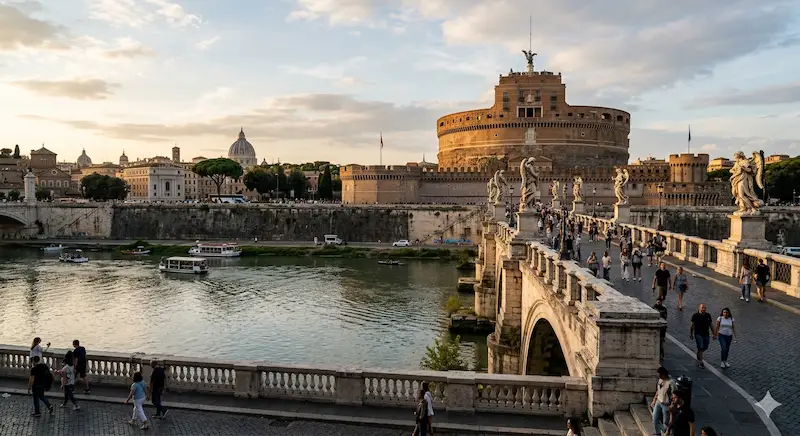
Standing along the Tiber River, the Castel Sant’Angelo is one of Rome’s most fascinating landmarks. Unlike most monuments, it has changed purpose multiple times over the centuries, reflecting the evolution of the city itself.
For first-time visitors, understanding this transformation adds a completely new layer to the experience. This is why many travelers explore it through Rome guided tours, where its complex history and hidden passages become much clearer.
Originally Built as a Mausoleum
Castel Sant’Angelo was originally constructed as the mausoleum of Emperor Hadrian in the 2nd century AD.
It was designed to:
- house the emperor’s remains
- symbolize imperial power
- stand as a monumental tomb visible from afar
At this stage, it had nothing to do with defense or imprisonment. It was purely a symbol of legacy and memory.
Transformation into a Military Fortress
As the Roman Empire declined, the structure was incorporated into the city’s defensive system.
Its solid circular design made it ideal for protection. Over time, it became:
- a fortified stronghold
- part of Rome’s defensive walls
- a strategic point controlling access to the city
This marked the beginning of its transformation from a symbolic monument into a practical military structure.
A Refuge for Popes
During the Middle Ages and Renaissance, Castel Sant’Angelo became closely connected to the papacy.
A secret elevated passage, known as the Passetto di Borgo, links the castle to the Vatican City.
This allowed popes to:
- escape danger quickly
- take refuge during sieges
- maintain control during unstable periods
The building was no longer just defensive. It became a center of power and survival.
From Fortress to Prison
One of the most surprising roles of Castel Sant’Angelo was as a prison.
Over the centuries, it held:
- political prisoners
- enemies of the state
- controversial figures
Its thick walls and isolated structure made it ideal for confinement.
This phase reveals a darker side of the monument, where power was enforced through control and punishment.
Hidden Details Most Visitors Miss
Many visitors focus on the exterior, but the interior reveals its layered history.
Inside, you can find:
- narrow corridors and defensive structures
- papal apartments with refined decoration
- prison cells that contrast sharply with the upper levels
These elements show how the building evolved over time without losing its original core structure.
A Monument That Reflects Rome’s History
Few places in Rome represent the city’s transformation as clearly as Castel Sant’Angelo.
It has been:
- a tomb
- a fortress
- a papal refuge
- a prison
Each phase reflects a different moment in Rome’s history, making it a unique architectural timeline.
Final Thoughts
Castel Sant’Angelo is not just a monument. It is a structure that has continuously adapted to the needs of the city.
By understanding its transformations, visitors can see it not as a single building, but as a living record of Rome’s past.


