
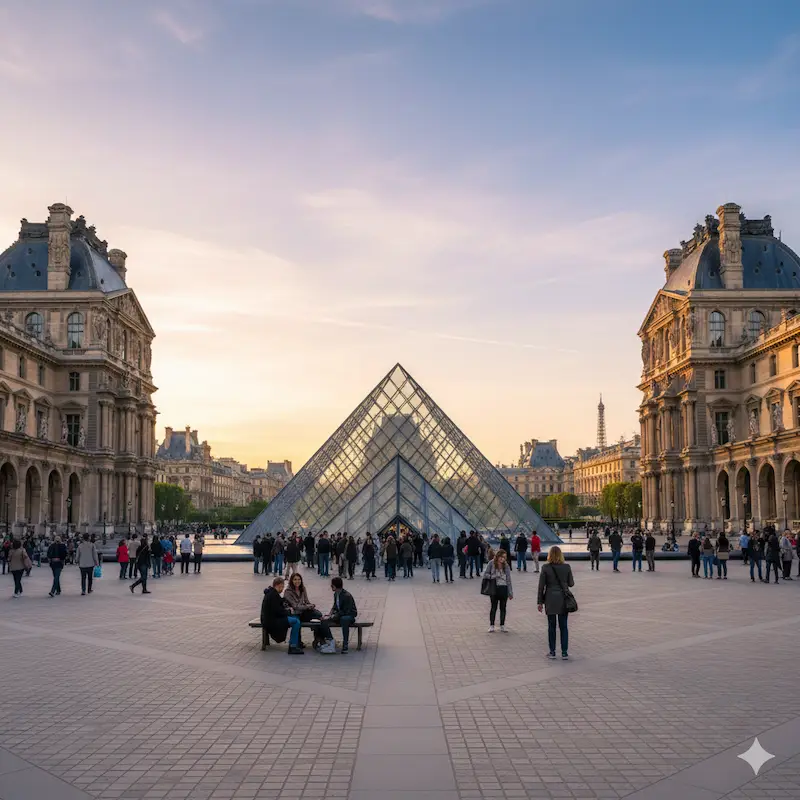
Today, the Louvre Museum is synonymous with art, elegance, and culture. Millions visit its galleries to admire masterpieces, rarely realizing that beneath the polished floors lies something far older and far more strategic: the remains of a medieval fortress built for war, not beauty.
To understand Paris beyond its museum façades, our Paris tours often explore the city’s layered past, revealing how iconic landmarks like the Louvre began as instruments of defense and royal authority.
A Fortress Built to Protect Paris
In the late 12th century, King Philip II ordered the construction of a massive defensive structure on the western edge of medieval Paris. At the time, the city was vulnerable to invasion from the Seine River.
The original Louvre was not a palace and certainly not a museum. It was a military fortress, designed to:
-
Guard the city’s river access
-
Store royal treasure
-
Demonstrate royal power
-
Protect against foreign threats
Thick stone walls, defensive towers, and a central keep made it one of the most formidable structures in the region.
The Great Tower Beneath Your Feet
The heart of the fortress was a massive cylindrical keep, known as the Grosse Tour. It rose high above the surrounding walls and served as both lookout and final defensive refuge.
Today, visitors can still see its foundations in the Louvre’s lower level. Massive stone blocks outline the original base of the tower, preserved beneath the museum’s modern galleries.
Standing there, it becomes clear: the Louvre was once built to intimidate, not inspire.
From Fortress to Royal Residence
As Paris expanded and threats diminished, the fortress lost its military necessity. Instead of demolishing it, successive kings transformed it into a royal residence.
Over time:
-
Defensive walls were softened
-
Windows were enlarged
-
Decorative elements were added
-
New wings replaced old battlements
The building evolved from a symbol of fear to a symbol of monarchy.
The Renaissance Transformation
During the 16th century, the medieval fortress was gradually dismantled to make way for Renaissance architecture. The rough military structure gave way to elegance and symmetry.
What once signaled protection and war now expressed refinement and cultural ambition. The Louvre began its transformation into a palace worthy of European courts.
The Revolution and a Radical Reinvention
The greatest transformation came during the French Revolution. The palace ceased to represent royal power and instead became a public museum.
This shift was revolutionary in every sense. A space built to defend a king became a space dedicated to public access and shared heritage.
Few monuments in the world have undergone such a dramatic symbolic shift.
Why the Fortress Still Matters
The preserved remains of the medieval Louvre remind visitors that:
-
Paris was once a fortified city
-
Power was expressed through stone and height
-
The museum stands on layers of ambition and survival
Without the fortress, there would be no Louvre as we know it today.
A Monument of Transformation
The Louvre’s history reflects the broader evolution of Paris itself:
-
From medieval insecurity
-
To royal grandeur
-
To revolutionary ideals
-
To global cultural leadership
Each layer still exists, physically and symbolically.
Final Thoughts
Beneath the world’s most famous museum lies a reminder that monuments are never static. The Louvre began as a fortress built for defense and dominance. Over centuries, it transformed into a palace, then into a museum open to the world.
To walk through its galleries is to move across time—to stand above the stones that once guarded a city and now protect its artistic legacy.


