
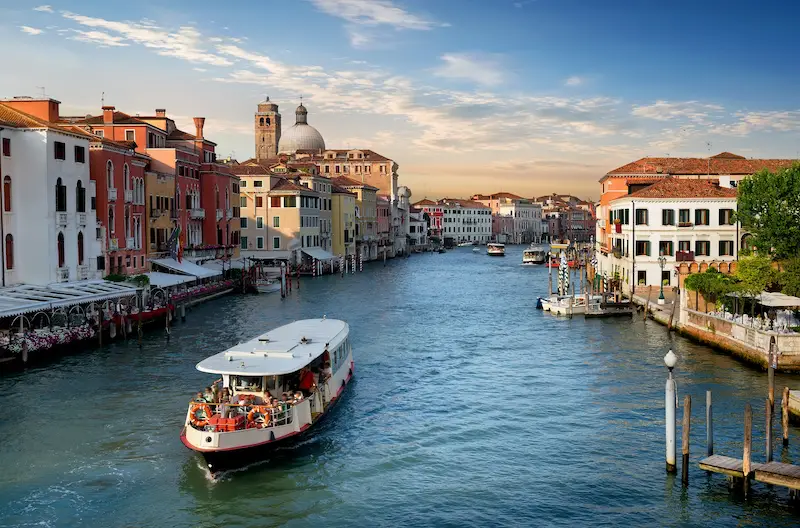
Walk whenever you can, take the vaporetto along the Grand Canal and to the islands, and save the water taxi for luggage or a late night. Venice has no cars, no bikes, and no metro — just your feet and boats. Getting the balance right is the difference between a relaxed visit and one spent waiting at crowded jetties. Here’s what each option is actually for.
First, the Thing Nobody Expects
Venice is smaller than it feels, and walking is faster than you’d think.
The city is built on more than 100 small islands, connected by over 400 bridges, with stone-paved alleys instead of streets. That sounds like a maze, and it is — but it’s a compact one. You can cross the entire historic centre on foot in about 40 minutes. Most of the time, the walk between two points is quicker than working out the boat connection, waiting for it, and riding it.
This single fact should shape how you get around: walking is the default, and the boats are for specific jobs.
Walking: The Default
Use it for: almost everything within the historic centre.
Walking is free, it’s the fastest option for most short distances, and it’s how you actually see Venice — the quiet canals, the small squares, the shops and workshops that you glide past invisibly on a boat.
What to know:
- Wear proper shoes. Venice is stairs and bridges. Every canal crossing is a small climb, and by the end of a day it adds up.
- Getting slightly lost is normal, and fine. The city is bounded by water; you can’t go far wrong, and the wrong turns are often the best part.
- Signs point the way. Yellow signs on building corners point toward the major landmarks — Per San Marco, Per Rialto, Per Ferrovia (the station).
Where walking fails you: long distances end to end, crossing the Grand Canal (only four bridges span it), and hauling luggage over stepped bridges. For those, you need a boat.
The Vaporetto: The Public Option
The vaporetto is Venice’s water bus, operated by ACTV. It’s the backbone of public transport and the option you’ll use most after your own feet.
Use it for:
- The Grand Canal, when you want the ride as much as the transport — it passes the great palaces end to end
- Getting to the islands — Murano, Burano, Torcello
- Long hops across the city when walking would take too long
- Arriving or leaving with the length of the city between you and your hotel
What to know:
- Buy a timed travel pass, not single tickets. Single rides are expensive for what they are; a 24-, 48-, or 72-hour pass pays for itself quickly if you use the boats more than twice a day.
- It gets crowded. The lines along the Grand Canal, especially near St. Mark’s and Rialto, are busy through the middle of the day, and it is not a relaxing experience at peak times.
- It’s not always faster than walking. For a couple of stops, the wait plus the ride often loses to a brisk walk.
For the Grand Canal specifically — which palaces to watch for, the best stretches, where to sit — our Grand Canal guide covers the route in detail. Taking the vaporetto down it once, ideally early or late in the day, is one of the essential Venice experiences.
The Water Taxi: The Expensive Convenience
Private water taxis are the sleek wooden motorboats you’ll see gliding past the vaporetti. They’re genuinely useful, and genuinely expensive.
Use it for:
- Arrival and departure with luggage — from the airport or the cruise terminal to a hotel, avoiding the stepped bridges entirely
- Late-night transport, when vaporetti run infrequently
- A splurge, when the private ride down the Grand Canal is the point
What to know:
- They are costly. Water taxis are used by locals only for quick or late-night trips precisely because of the price. Agree the fare or confirm it’s metered before you set off.
- They can’t reach everywhere. A water taxi gets you to the nearest canal-side point to your destination — you may still have a short walk with your bags.
- For airport transfers, they’re worth considering despite the cost: the alternative with luggage is a longer public route and a walk over bridges.
The Gondola: Not Transport
Worth stating plainly: the gondola is an experience, not a way of getting around. It’s slow, it’s priced for tourism, and it doesn’t take you anywhere in particular — that’s not a criticism, it’s the point.
A gondola ride, especially at sunset, is one of the loveliest things to do in Venice. Just budget it as an activity, not a transfer. Our guide to sunset gondola rides covers when and where to take one.
What to Use, When
| Situation | Best option |
| Getting around the centre | Walk |
| A couple of stops | Walk — usually beats the boat |
| The Grand Canal, for the views | Vaporetto |
| To Murano, Burano, Torcello | Vaporetto |
| Arriving/leaving with luggage | Water taxi |
| Late at night | Water taxi |
| A romantic hour on the water | Gondola |
| Crossing the Grand Canal quickly | Walk to a bridge, or the traghetto |
The traghetto deserves a mention: it’s a stripped-back gondola that ferries locals straight across the Grand Canal at a few points, for a small fare. It’s the cheapest boat ride in Venice and the quickest way over the canal where there’s no nearby bridge.
The Mistakes That Cost You
- Buying single vaporetto tickets one at a time. The passes exist for a reason; single fares add up fast.
- Taking the vaporetto for two stops. You’ll often wait longer than the walk would take.
- Not accounting for luggage. Stepped bridges and wheeled suitcases are a bad combination — plan your arrival around a water taxi or a vaporetto stop close to your hotel.
- Treating the gondola as a transfer. It isn’t one, and pricing it as transport leads to disappointment.
- Underestimating how walkable it is. The single most common surprise: people boat everywhere and miss that the city is a 40-minute walk across.
For a sense of how Venetians themselves move through the car-free city — and why walking is so central to daily life here — our article on living without cars in Venice is a good companion to this one.
If you’d rather have the logistics handled entirely on your first day, a guided tour takes the navigation off your plate while you find your feet. See our Venice tours for the options.
FAQ
What’s the best way to get around Venice?
Walking, for most of the historic centre — it’s compact, and often faster than the boats for short distances. Use the vaporetto for the Grand Canal, the islands, and longer hops, and a water taxi for luggage or late nights.
Is the vaporetto worth it?
Yes, especially with a timed travel pass rather than single tickets. It’s the most economical boat transport and the best way to ride the Grand Canal or reach the islands. For short two-stop trips, walking usually wins.
How much does a water taxi cost in Venice?
Water taxis are the most expensive option and are typically used only for quick trips, luggage transfers, or late-night travel. Confirm the fare before departing. For arrivals with heavy bags, many visitors find the cost worthwhile.
Can you walk everywhere in Venice?
Almost. The historic centre is crossable on foot in around 40 minutes, and walking is the fastest option for most short distances. The exceptions are the islands, long end-to-end trips, and crossing the Grand Canal, where only four bridges span it.
Is a gondola a good way to get around?
No — a gondola is an experience rather than transport. It’s slow and priced for tourism. Take one for the ride itself, ideally at sunset, but don’t rely on it to get anywhere.
How do I cross the Grand Canal without a bridge?
Take a traghetto — a simple gondola ferry that crosses at several points for a small fare. It’s the cheapest boat ride in the city.
Should I buy a vaporetto pass?
If you’ll use the boats more than twice a day, yes. The 24-, 48-, and 72-hour passes cost far less than the equivalent single tickets.


